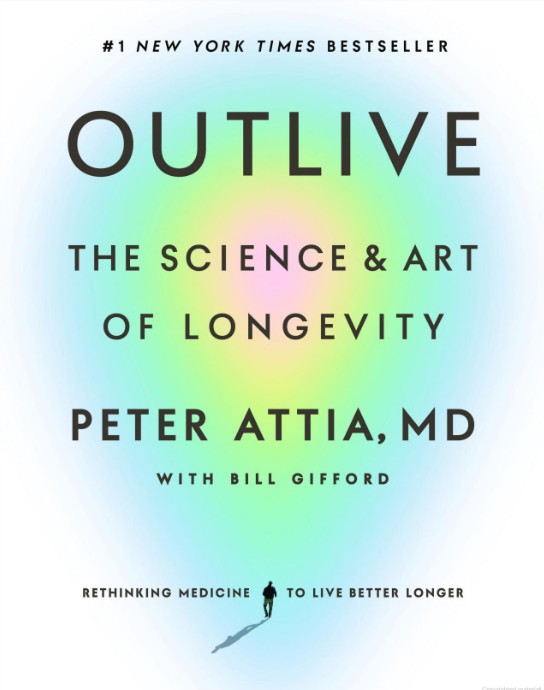
I run every day and workout at the gym three days a week, though my conditioning and performance have plateaued and then declined as I have aged up. I continue to “mature” as a runner athlete and have confronted these physical limitations because of my current physiology. Such as it is. What additional knobs can I turn to maintain my health and fitness, to stay in good health and compete over the next decade? Likely the answer lies in diet and training practices. While browsing at the bookstore I came across this book Outlive – The Science and art of Longevity. -Peter Attia, MD and was intrigued to read it through to provide a new perspective in order to support my health and physical wellness.
The author is a physician and a researcher in the area of longevity, and he has assembled a wealth of background information on the prevention of disease and physical deterioration related to the aging process. What did I have to lose? Here a few summarizations of the book content, learnings if you will that I can practically apply.
The premise of the book rests on the evolution of medical care and treatment from what he defines as Medicine 2.0 to Medicine 3.0 (Medicine 1.0 was pre-science). Dr. Attia’s concept of Medicine 2.0 is our current, largely reactive healthcare system that focuses on treating symptoms and late-stage chronic disease. In contrast, Medicine 3.0 is a proactive and personalized approach that emphasizes preventing chronic diseases and conditions by using advanced diagnostics, predictive lab work, and individualized protocols to optimize the quality of life – rather than just extending lifespan. Longevity is not merely restricted to the number of years that a person lives, but to ensure that the number of years are spent in good health, and free from major diseases and disability. He defines “Lifespan” as the number of years you live, and “Healthspan” as the number of years that you live in good health.
Medicine 2.0 (Traditional/Reactive Medicine) Focus: Diagnosing and treating illnesses after they manifest as symptoms. Approach: Primarily uses procedures (like surgery) and medications to manage existing conditions. Goal: To extend the lifespan once a disease is present.
Medicine 3.0 (Proactive/Preventative Medicine) Focus: Identifying and mitigating risk factors for chronic diseases long before symptoms appear. Approach: Integrates cutting-edge science, advanced diagnostics, personalized interventions (based on genetics, hormones, lifestyle), and functional medicine. Goal: To maximize “healthspan”, improving the quality of years spent in good health, by preventing disease onset.
Reactivity vs. Proactivity: Medicine 2.0 is reactive, while Medicine 3.0 is proactive. Disease Focus: Medicine 2.0 treats existing diseases; Medicine 3.0 prevents their occurrence. Outcome Goal: Medicine 2.0 aims to extend life; Medicine 3.0 aims to improve “healthspan”.
See also: Dr. Peter Attia And The Advent Of Medicine 3.0
Societal health involves a long game, from fast death to slow death. 100 years ago, when lifespans were much shorter, the primary causes of death were accidents, injuries, and infectious disease. In the 21st century, aside from accidental death, most people will die from of the chronic diseases of aging as he describes, the four horsemen: heart disease, cancer, neurodegenerative disease, or type 2 diabetes and related metabolic dysfunction. He covers in some detail the early diagnosis, testing and preventative measures which can forestall the progression of these conditions.
Peter on the four horsemen of chronic disease – Peter Attia The Four Horsemen of Chronic Disease account for over 80% of deaths in people over 50 who do not smoke…
- Atherosclerotic disease (comprised of cardiovascular disease and cerebrovascular disease), accounts for around 19 million deaths globally per year
- Cancer accounts for approximately 10 million global deaths per year.
- Neurodegenerative disease (Alzheimer’s disease being the most common), account for 9 million global deaths annually.
- “Foundational disease” ⇒ a spectrum of everything hyperinsulinemia to insulin resistance to fatty liver disease to type 2 diabetes. Zooming in on diabetes, this disease alone accounts for roughly 1.5 million global deaths.
Fortunately, these conditions do not rise overnight. Rather, they develop over the years. The emergence of the Four Horsemen can therefore be prevented – or their progression stopped – through proactive measures such as treatments and lifestyle adjustments.
Exercise and stability Dr. Attia describes exercise as the most powerful longevity drug. “Study after study has found that regular exercisers live as much as a decade longer than sedentary people. Poor cardiorespiratory fitness carries a greater relative risk of death than smoking”!! And of course, they stay in better health – they extend their “healthspan”. He argues that the predicted loss of muscle mass with age literally puts our lives at risk, especially from falls, which often result in debilitating injuries. There is a strong statistical correlation of falls with early death – I knew this intuitively, but the data correlation is much stronger than I expected. For this reason, he puts great emphasis on weight training to promote increased muscle mass. These support increased functionality for lifting, carrying and balance.” Strength training, especially with heavy weights, stimulates the growth of bone.”
Strength Training: I have been going to the YMCA for almost 20 years now, at some point I decided that it would be helpful to strengthen my core and perhaps not look so much like a skinny run guy. It is unclear that those extra pounds of muscle have helped my running economy, but I felt better, and stronger as well. Mike and I used to go together when he was living at home and then I just stayed with it. “It takes much less time to lose muscle mass than to gain it. Even if a person has been training diligently, a short period of activity can erase many of those gains.” Dr. Attia recommends structuring exercises around the following four areas. The focus is especially on grip strength and core strength.
1. Grip Strength
The first point defines grip strength as how hard you can grip with your hands. It clarifies that this doesn’t just involve your hands but also extends to the large muscles in your back, known as the lats. The text emphasizes that almost all physical actions begin with a grip.
2. Concentric and Eccentric Loading The second point focuses on the importance of paying attention to both concentric and eccentric loading during movements. Concentric loading occurs when muscles are shortening (e.g., lifting a weight up). Eccentric loading occurs when muscles are lengthening (e.g., slowly putting the weight back down with control). The text provides an example: ruck marches down hills are a great way to work on eccentric strength because they force you to “put on the brakes.”
3. Pulling Motions The third point describes pulling motions, which are exercises performed at various angles, from overhead to in front of you. These motions, such as pull-ups and rows, also require grip strength.
4. Hip-Hinging Movements The fourth point covers hip-hinging movements. These exercises include the deadlift and squat, as well as other variations like step-ups, hip-thrusters, and various single-leg exercises. These movements are designed to strengthen the legs, glutes, and lower back.
He also is a big advocate of rucking – I am seeing more folks around the neighborhood doing this and wasn’t sure what the point was. Again, it is about working on the core and improving stability. Also to prevent falls. Rucking, or walking with a weighted backpack, offers a variety of benefits for both physical and mental health. Benefits include:
- Improved cardiovascular fitness: Rucking increases your heart rate and circulation, strengthening your heart and improving endurance. The added weight elevates your heart rate more than standard walking and can provide comparable cardiovascular effects to jogging with less impact on your joints.
- Increased strength and endurance: Carrying weight engages muscles throughout your body, including your legs, glutes, core, back, and shoulders, leading to increased muscle strength and endurance. In fact, one study found that participants had lower ratings of perceived exertion after a 10-week load-carrying program, while their muscular power and oxygen intake also improved.
- Boosted calorie burn: The added weight forces your muscles to work harder, increasing your energy expenditure and burning more calories than regular walking. Depending on the weight and intensity, you can burn up to 50% more calories than walking without a load.
- Low-impact exercise: Rucking is gentler on your joints than high-impact activities like running, making it a good choice for those with joint pain or recovering from injuries.
- Improved posture: The weight in a rucksack naturally pulls your shoulders back and encourages proper spinal alignment, helping to correct slouching and improve posture.
- Enhanced functional fitness: Rucking mimics everyday activities like carrying groceries or lifting children, which can improve overall strength, balance, and longevity.
- Increased bone density: Weight-bearing exercises like rucking can stimulate bone growth and density, crucial for preventing osteoporosis and maintaining strong bones as you age.
Nutrition and eating patterns: So much to unpack here. He covers many of the nutrition trends that have emerged over time. “The correlation between poor metabolic health and being overnourished is very high. Hence, for a majority of patients the goal is to reduce energy intake while adding lean mass. This means we need to find them (patients) ways to consume fewer calories while increasing their protein intake, and to pare with proper exercise. This is the most common problem we are trying to solve around nutrition.”
Protein should account for 10% to 35% of your calories, according to the American Heart Association. On a 2,000-calorie-a-day diet, that’s 200 to 700 calories from protein, or 50 to 175 grams. The Department of Agriculture has a calculator of dietary reference intakes to help you determine how much protein you need. The recommended dietary allowance is 0.8 grams of protein per kilogram of body weight, or 0.36 grams per pound. That means a 50-year-old woman who weighs 140 pounds and who doesn’t exercise would need 53 grams of protein a day. On the other hand: Doctors Think We Need To Cool It With Our Obsession With This 1 Nutrient
I have eliminated a lot of processed foods, though not completely; that is impractical for me, I think. In his practice the author has patients wear Continuous Glucose Monitors to track food impacts – I could see where these would be useful if you were on a strict program. These are still only by a doctor’s prescription.
A fascinating section on fasting and calorie restrictions: “From the standpoint of efficacy to lose weight, caloric restriction is the winner, hands down.” Studies are mixed about whether a long-term restricted calorie diet can prolong lifespan, though it is certainly good for your ongoing health if composed of a proper balance of nutrients. He touches on the use of alcohol (generally a no) and various nutrition schemes that favor protein over carbohydrates / fats (overall generally good).
Various fasting approaches are also discussed (time restricted eating (regulating when you eat). The scientific research is still relatively weak and there are some advantages for those trying to reduce weight, but it is not a panacea. There are several variations on this, from shortened time windows (18/6 hours or 16/8) to alternate day fasting. The key is to maintain a proper nutritional balance and avoid overeating when breaking fasts.
Sleep: “Each night when I go to sleep, I die. And the next morning, when I wake up, I am reborn.” -Mahatma Gandhi. Seven and a half to eight and a half is a recommended sleep cycle, we all fall down on that. I have a tendency to fall into a sleep deficit throughout the course of the week and try to make it up towards the weekend. Early morning runs have many benefits, yet I yearn for an occasional sleep in day
And finally, Mental Health: The author shares his own mental health challenges and treatments, a good honest revelation.
So, what will I do differently?? I keep the book as a reference now, and with a renewed commitment to health and fitness. In any case, preparing to meet my run goals has upped my commitment to training and health. Small things add up I hope
- Increasing the intensity of my core and upper body workouts
- Reducing carb intake by 25% and increasing protein; cutting out extra foods and reducing volumes at mealtimes. Sustain a 5–7-pound weight reduction.
- Keeping on schedule with my multi-vitamins and iron supplement – though not sure how helpful these are.
- Increasing nightly sleep by 30 minutes on average.
- Funny how setting a goal does that every time.
Attached are some links to his websites and podcasts. Feel free to explore these and best of luck in pursuing your health and fitness goals.