I have been voting in Texas for close to 30 years. My participation has never resulted in successful election of my preferred candidates. Suddenly now, in a surprise, that all changed this year.
Economic, domestic and international issues can be a challenge for any elected administration. Our country has great resources and a committed electorate on both sides of the aisle. Despite entrenched policy disagreements it is quite possible to run this country with a modicum of success – if you hire the right people and take rational advice. That did not happen. I think there is always a tendency for overreach for the party in power to take advantage of their time to push initiatives while the opportunity presents itself; Democrats and Republicans alike.
And a reminder that at the end of the day, as has been stated on many occasions, “it’s the economy, stupid.” Leading up to this election there were signs that the tide was turning in a more progressive direction, but we have been here before. Especially in Texas.
Two years ago, I wrote this after the national elections of 2024: election lookback – Welcome
In that essay I tried to consider and share the drivers that shaped the vote in that consequential election cycle. The logic of that discussion still holds true for the most part; administrations lose support after two years in office. “Looking back through past election cycles, American are perpetually unhappy with the incumbent administrations. Unhappiness in voter’s lives is directed outward to the government, especially as related to income / spending, personal financial security, regulation, and control….” And I added that the 2024 results were driven by the following: Inflation – as an aspect of the general economy and upward mobility. Immigration – in the sense of a threat to my “tribe”, or a perceived threat to my livelihood. The Cult of Personality – as it applies to presidential candidates. I also noted that the election was lost because of a failure to hold or increase election turnout, particularly among younger voters.
And this, what next? “Truth be told, the policies enacted through a Republican congress and presidency will not materially affect my life. The economy is a huge machine, and it is hard to steer it, or wreck it, by working around the edges. Perhaps the promise of AI will drive economic growth to new levels. Or other yet unrecognized drivers of employment and spending may create a recession. The electorate will likely swing back toward more center or left of center policies, or we may be seeing a systemic move to the right. I do not know. We will see in two years. Let the Republicans have the car keys for a while and see what they might break and go forward from there.”
The car has been driven for two years now and the verdict is in. During that time, I tried multiple news blackouts but still followed the events – and was amazed at the self-destruction that occurred over the past two years of the federal and state administrations. Americans as a majority are again unhappy with national leadership and the direction of the economy. The drivers at the national level were somewhat different than at the state level as here in Texas, though with much overlap. There are some nuances to the change; at the national level these looked like the drivers to me:
Continued inflation, modest though against the backdrop of slowing job growth exacerbated by tariffs, and the impacts of an unpopular war with Iran on gasoline and diesel prices. A backlash against extreme immigration / social policies and visible examples of corruption. With all of this against a backdrop of AI fears, the K shaped economy and loss of government benefits for some households. All of these overlay the larger backdrop of demographic changes in voting patterns across the country.
Inflation is a sticky partner in our daily lives. The long cycle causes are many and complex: The Rabbit-Duck Question: What Caused the Recent Inflation Surge? | Richmond Fed Recent increases were driven most visibly by the of tariff policy and the increase in fuel costs that have trickled into production and transportation impacts. Other factors include higher housing and labor costs. Sustained consumer demand for products and services has allowed companies to maintain or increase prices without a significant loss of market share. Companies will continue to raise prices if they can without losing market share. Airlines are a good example of this. Personally, I noticed it most in airline fares for sure, and also gas, restaurants and groceries.
For many households’ wage growth is not keeping up with income increases. According to Yahoo Finance’s calculations, consumer prices rose about 4% in the year through October, up from 3.7% in September. Paychecks didn’t keep up. Average hourly pay rose about 3%, which leaves pay down nearly 1% after inflation. That’s the seventh straight month workers have lost ground, matching May as the worst stretch of the run. American paychecks are losing to inflation again — here are the most painful categories
Since October 2024, average hourly pay has increased by about 7%. Here’s what outran it. Airfares jumped more than 20%. Car repairs rose by about 13%, hospital services by about 12%, and electricity by nearly 10%. A meal at a sit-down restaurant costs about 9% more. Groceries are the exception, up only about 5%.
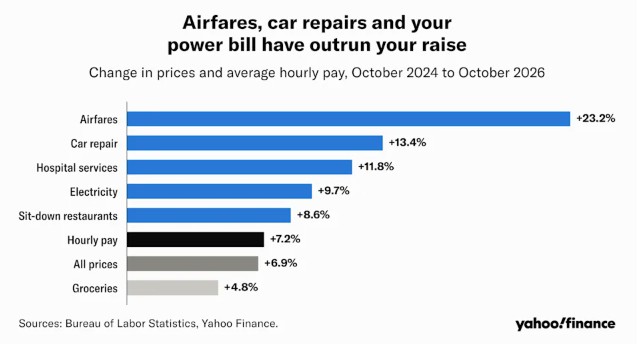
“According to a New York Federal Reserve Report and studies from the Federal Reserve system, removing tariffs and stabilizing fuel costs would have significantly lowered overall inflation over the past two years:”
Consumer Goods Impact (Tariffs): A study by the New York Federal Reserve estimated that consumer goods inflation was roughly 2.9 percentage points higher as a direct result of recent tariffs on dozens of import categories. Without these levies, prices for those studied consumer goods would have declined by nearly 1% rather than increasing. Each 1 percentage point tariff increase historically raises consumer goods prices by about 0.25% annually.
Key Impacts of Higher Fuel Prices, driven largely by conflict in Iran and tight global refining capabilities
- Gasoline and Diesel Surge: Gasoline prices have jumped roughly 31% to 34% over the past year, while diesel prices have hit record highs exceeding $6 a gallon.
- Direct Contribution to Consumer Price Index (CPI): Gas and fuel oil prices have accounted for a massive portion of the recent headline inflation acceleration, with overall annual CPI climbing to 3.7%.
- Spillover into Transportation and Services: Higher fuel has directly inflated operating costs for other sectors, leading to sharp increases in:
- Airfares: Up roughly 22% to 23.4% year-over-year as airlines pass jet fuel costs to travelers.
- Delivery and Shipping Services: Up around 16%, raising transit expenses for goods, restaurants, and grocery chains.
- Electricity and Utilities: Rising energy generation and distribution expenses pushed electricity prices up 0.9% in a single month (October).
- Household Budget Strain: According to economic trackers like Moody’s Analytics, the typical U.S. household has spent over $1,043 extra on combined fuel expenses (gasoline, diesel, home heating, and jet fuel) over the course of the energy surge.
- Broader Pass-Through to Goods: Higher shipping and electricity costs have begun bleeding into core categories, lifting prices for groceries (beef and restaurant meals) and consumer electronics. You can monitor ongoing Consumer Price Index updates via the U.S. Bureau of Labor Statistics.
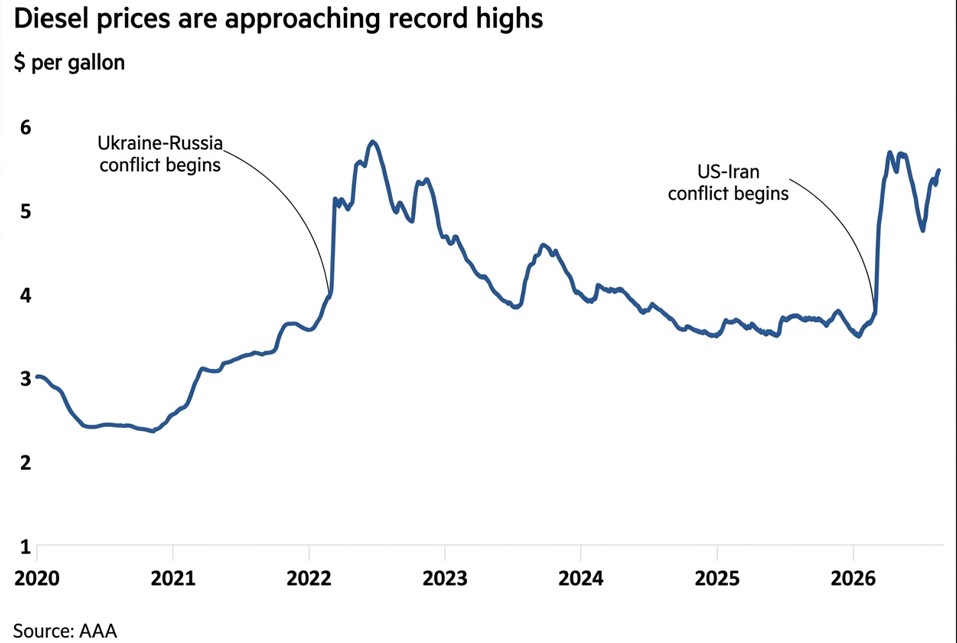
U.S. Diesel Prices (1994-2026)
Demographic trends, immigration overreach, social policies and visible examples of corruption. Public school policies and the Texas blue tsunami Demographic impacts have been in sight, and then just over the horizon for years on end, but everyone (repeatedly) mis-calculated when those would arrive. When exactly would those changes tilt the Texas electorate from a red state toward blue, and in other states across the country? The timing was always uncertain. For various reasons demographic changes never moved elections away from the voter base that reliably turned out favored older and more conservative voters. There were early signs of generational change at the in 2018, 2020 and 2022, but not enough to tip the elections, and so the government at the state level across much of the South and Midwest remained strongly Republican. Younger voters in 2024 pulled away from the Democratic party or stayed at home.
Republicans’ 2024 gains among young voters were reversed in these midterms, as voters under 30 suddenly (and overwhelmingly) preferred Democratic candidates at all levels of state government. Seventy-three percent of voters under 30 cast ballots for Democratic midterm candidates for the House of Representatives, and young men swung back to Democrats, according to exit polls from the Nov. 3 election. Only 25% of young voters cast ballots for Republican candidates. Democrats won 62% of voters ages 30-44 and 52% of those 45-64. Republicans’ strongest age group was Americans 65 and over, who split their votes precisely 50-50 between the two parties. In 2018, the last time Democrats enjoyed a strong midterm election, 68% of young voters cast ballots for Democrats in the House.
Are Democrats’ Stunning Midterm Upsets in Deep-Red States a Blip—or Is Their Map Expanding? AP Voter Poll: How key demographic groups voted in the 2026 midterms | PBS News
Americans ages 18-29 have a history of turning out at lower rates than older voters, and this year was no exception. Gen Z made up 11% of the total vote this year. However, where young Americans may have made the greatest difference, is on the margins in House and Senate races where Democrats flipped seats. The Texas Senate race is a key example. Democrat James Talarico won the state by 12 percentage points, however, when looking at just Gen Z, he won it by 60 points. 2026 midterms: How Gen Z voters helped fuel a blue wave : NPR
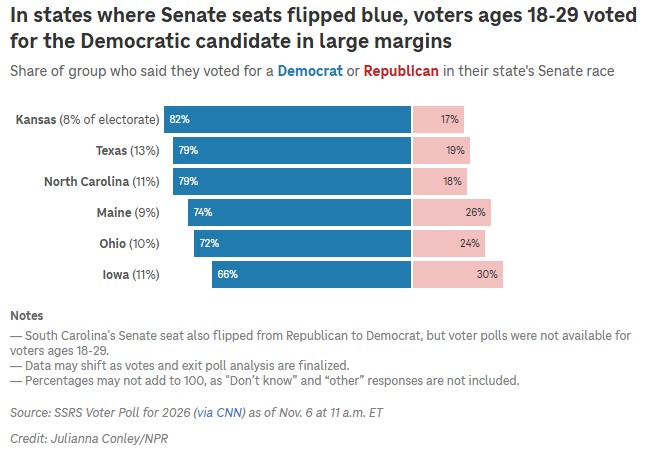
In Texas, and across the country, an exhaustion with the current president, perceptions of corruption and the continued promotion of “stale” cultural issues by the Republican majority fueled the case for change. Texas saw tremendous pushback (especially among teachers and students) against the state’s educational agenda. State initiatives had prioritized greater conservative control over local school district administrations, standardized elementary / secondary curriculums and university programs. The governor’s school voucher program was unpopular, especially in rural areas. What was the governor thinking?? Texas votes were also driven by a more forceful pushback against immigration policies across urban and southern Texas border counties. Democratic sweeps in Texas fueled by anger over GOP education agenda, advocates say
A summary of issues related to the impact of school vouchers in Texas: A Case Against School Vouchers | Texas Association of School Administrators Voucher program could cost Texas schools close to $300 million in funding, new report shows – Houston Public Media “A public school district can’t reduce expenses dollar for dollar when a student leaves with a voucher because many of those costs, such as transportation, utilities, insurance, teachers – those are fixed costs… funding losses may force districts to make major cuts.”
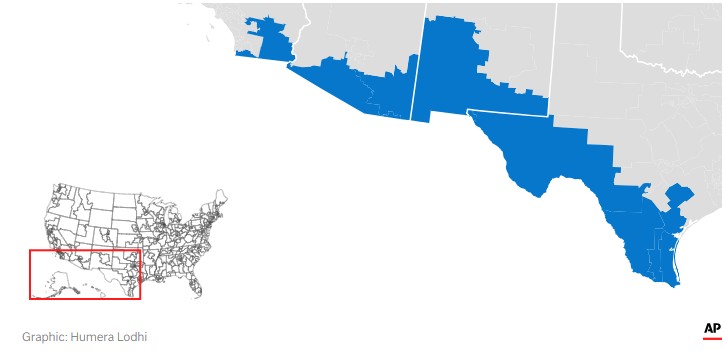
Democrats won every House district that touches the U.S.-Mexico border — which includes seats in Texas, New Mexico, Arizona and California — for the first time since 2008. Urban, border county turnout fueled Texas blue wave Latino voters swing left in midterms, lifting Democrats to big wins | AP News
Finally, a shoutout to Gina Hinojosa, who ran a lonely campaign for the governorship, starting out with little money or name recognition, but was on the right side of the issues that mattered to many Texans. And a sincere, nice person through it all.
Here we are at mid-cycle, with a change in congress at the national level, and leadership at the state level. Some oversight will change and likely a curb on the more destructive impulses of the Republican majority. Due to executive leaders at the national level and republican majority in the Texas Senate, it is unlikely that major legislative changes will occur. The voters can live with that for now, and plan to take another swing in 2028. The next election cycle will soon be upon us.